

If you’ve ever found yourself guessing a student’s level in an online ESL lesson and hoping it works out, you’re not alone.
Many online ESL teachers rely on instinct instead of a clear ESL placement assessment—especially with new students, transfer students, or learners who fall “somewhere in between” levels.
Why Guessing Student Levels Is a Problem in Online ESL Teaching
Level guessing doesn’t usually come from carelessness. It comes from:
- Limited information at the start
- Pressure to “just start teaching”
- A lack of clear tools for placement
- Wanting the student (or parent) to feel confident right away
The problem isn’t the intention.
The problem is what guessing quietly does to your lessons.
When a student is even slightly misplaced:
- Lessons feel harder to pace
- Activities don’t land the way you expect
- You start compensating by over-explaining or simplifying
- Progress feels slower — even when the student is trying
And eventually, teaching starts to feel more tiring than it should.
Signs a Student Is Placed Too Low (Even If They’re Doing “Fine”)
Students placed too low don’t always complain. In fact, they often seem comfortable — at first.
Common signs include:
- They finish tasks very quickly
- They give short, automatic answers
- They rely on prior knowledge instead of the lesson content
- Engagement drops after the first few lessons
As a teacher, this often shows up as:
- Stretching activities to fill time
- Adding “extras” mid-lesson
- Feeling like you’re working harder than the lesson requires
The student isn’t being challenged — and you’re doing extra mental work to compensate.
Signs a Student Is Placed Too High For Their ESL Level
Students placed too high often look motivated on the surface.
They:
- Try hard
- Say “I understand” (even when they don’t)
- Follow instructions carefully
- Apologize when they struggle
But underneath, you may notice:
- Hesitation when speaking
- Heavy reliance on repetition
- Confusion during reading or listening tasks
- Progress that feels inconsistent
For teachers, this often leads to:
- Slowing down constantly
- Re-teaching concepts that “should” already be known
- Second-guessing your lesson choices
- Feeling responsible for the student’s struggle
This is exhausting — and unnecessary.
The Real Issue Isn’t Experience or Skill
When lessons feel harder than they should, many teachers assume:
- “I need better activities.”
- “I should plan more.”
- “Maybe I’m not explaining this well.”
But very often, the issue isn’t your teaching at all.
It’s the starting point.
Without a clear, reliable sense of a student’s level, every lesson requires extra decisions:
- How much support to give
- Whether to simplify or extend
- Whether confusion is normal or a red flag
That mental load adds up quickly.
When to Reassess ESL Student Levels
Placement isn’t a one-time event. Even strong initial assessments benefit from reassessment at key moments.
Consider reassessing when:
- A new student joins mid-year
- You inherit a student from another teacher
- January begins (after long breaks or schedule changes)
- Lessons start feeling consistently “off”
- Progress feels stalled despite effort
Reassessment isn’t an admission of failure.
It’s a professional reset.
How ESL Placement Assessment Supports Better Teaching
A clear ESL placement assessment helps teachers understand what a student can actually do with English—not just what they recognize or repeat.
When student levels are assessed accurately, ESL lessons become easier to plan, smoother to teach, and more consistent over time.
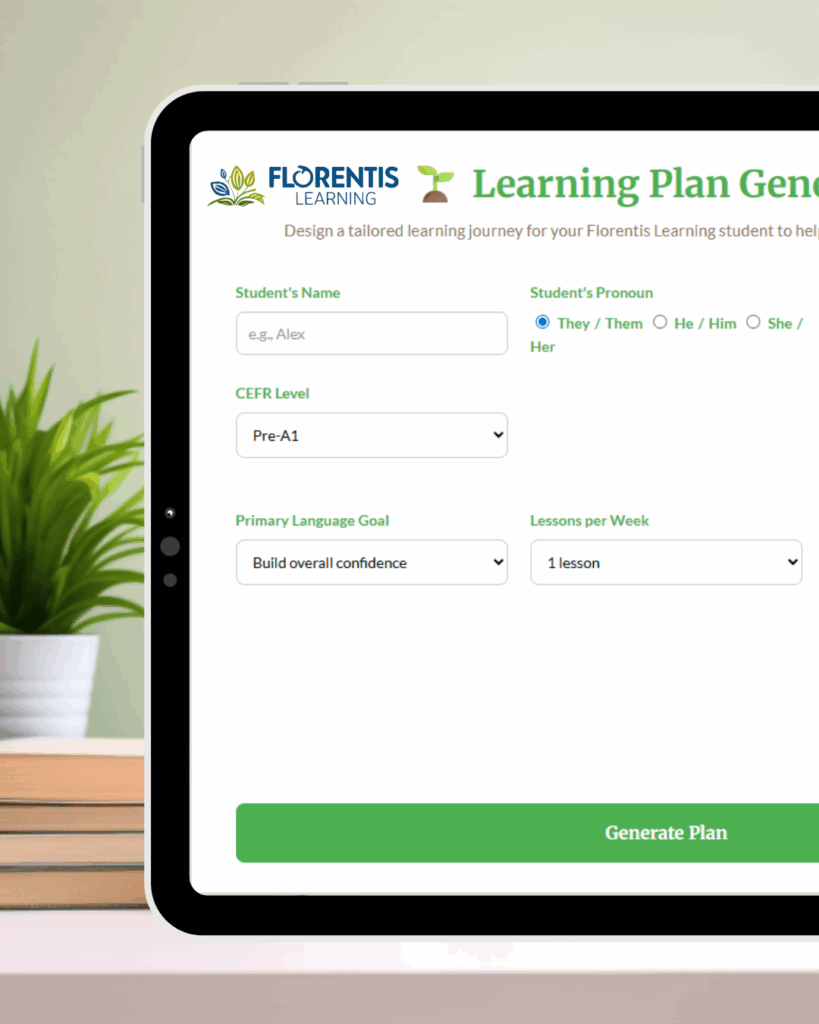
After completing the ESL Placement Assessment, you can use the free Learning Plan Generator from Florentis Learning to build a professional learning plan you can share with the parents.
What Changes When You Stop Guessing
When student levels are clear:
- Lesson pacing becomes easier
- Planning takes less time
- You stop mentally adjusting every activity
- Students feel more confident — even without knowing why
Most importantly, teaching starts to feel lighter.
Not because you’re doing less — but because you’re no longer carrying unnecessary uncertainty into each lesson.
A Simple Way to Remove the Guesswork
This is exactly why we created a free ESL placement assessment.
It’s designed for online teachers who want:
- A clearer starting point
- Better lesson alignment
- More confidence in their planning decisions
The assessment helps you:
- Identify a student’s functional level
- Place them more accurately within a structured curriculum
- Reduce trial-and-error teaching
- Start lessons with clarity instead of uncertainty
And because it’s free, it’s easy to use:
- With new students
- As a January reset
- Or whenever something feels “off”
You’re Not Behind — You Just Need Better Signals
Guessing student levels doesn’t mean you’re doing anything wrong.
It means you’ve been doing your best without enough information.
Clear placement isn’t about labels.
It’s about giving both you and your students a smoother path forward.
👉 Try the free ESL placement assessment
Remove the guesswork and start teaching from a clearer starting point.
Leave a Reply