

Many online ESL teachers feel organized — at least on the surface.
They have lesson folders, saved PDFs, planning notebooks, and templates ready to go. But once live lessons begin, teaching still feels harder than it should.
That’s usually when teachers start looking for better organization.
What they actually need is an ESL teaching system.
Why “Being Organized” Isn’t the Same as Having a System
Binders, folders, and PDFs can look very organized — but they don’t do anything during a lesson.
They don’t:
- Tell you what to teach next
- Help you adjust pacing in real time
- Reduce the number of decisions you make
- Hold context from previous lessons
That’s why many teachers feel prepared before class… and overwhelmed during class.
Organization stores information. A system supports decisions. That difference is critical in an online ESL teaching system, where decisions happen live and quickly.
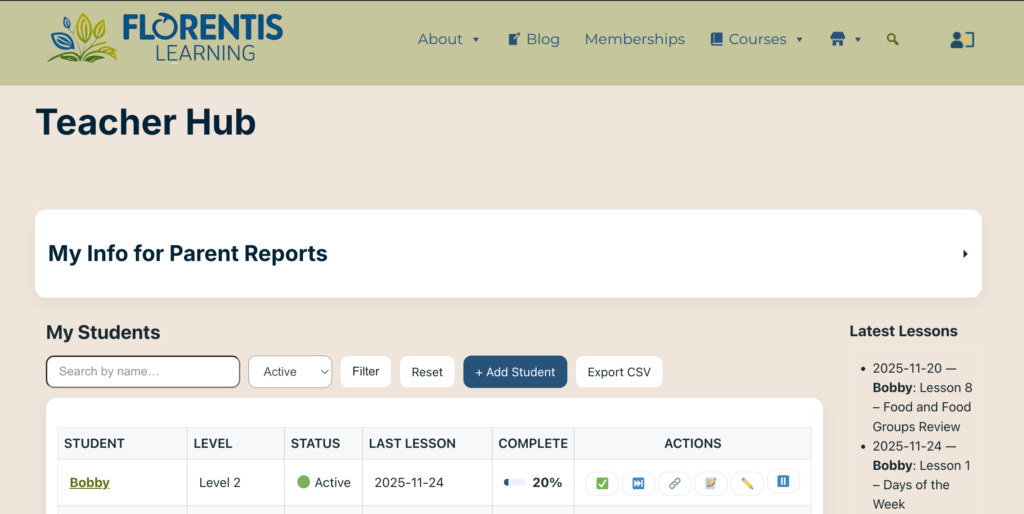
This is what supporting teaching decisions looks like in practice.
What an ESL Teaching System Actually Is
An ESL teaching system isn’t a product or a platform.
An ESL teaching system is the structure that connects lessons, tracks progress, and supports your teaching decisions during live online ESL lessons — so teachers aren’t rebuilding context every time you open Zoom or Koala Go.
A real ESL teaching system quietly answers questions like:
- What should I teach this student next?
- How does this lesson connect to the last one?
- What does progress actually look like here?
- Where do I pick up next time without rethinking everything?
When an ESL teachign system is in place, it:
- Reduces decision fatigue
- Creates consistency across lessons
- Holds student context so you don’t have to
- Makes teaching feel smoother and lighter over time
Most importantly, an ESL teaching system works during lessons – not just during planning.
What an ESL Teaching System Is Not
This is where confusion often happens.
A system is not:
- A stack of printable worksheets
- A growing Google Drive folder
- A lesson library without structure
- A planner you still have to interpret every time
Those things can be helpful — but on their own, they still rely on you to connect the dots.
When teachers say, “I have resources, but I still feel scattered,” this is usually why. This is why many ESL teachers feel busy but unsupported.
Why Systems Matter Most in Live Online Lessons
Online ESL teaching demands constant micro-decisions. This is especially true in online ESL teaching, where pacing, engagement and comprehension must be adjusted in real time.
- Do I slow down or move on?
- Do I review or introduce something new?
- Is this confusion normal or a sign of misplacement?
- What’s the next logical step for this student?
Without a system, every one of those decisions lives in your head.
With a system:
- The lesson sequence guides you
- Student progress is easier to interpret
- You stop reinventing choices each session
Teaching becomes less reactive — and more intentional.
How Systems Reduce Decision Fatigue for Teachers
Decision fatigue isn’t about teaching too many hours.
It’s about making too many choices without support.
A strong teaching system:
- Clarifies starting points
- Reduces second-guessing
- Creates predictable lesson flow
- Helps you reuse lessons with purpose
This doesn’t make teaching rigid. It actually creates more flexibility — because the structure is already there.
Why Experienced Teachers Rely on Systems (Even If They Don’t Call Them That)
Teachers with years of experience often say:
- “I just know what comes next.”
- “I can feel when it’s time to move on.”
- “I don’t overthink lessons anymore.”
What they’re really describing isn’t instinct — it’s internalized systems.
They’ve seen patterns.
They’ve taught sequences.
They’ve stopped making the same decisions from scratch.
Systems don’t replace experience. They help you build it faster — and with less exhaustion.
Where Florentis Fits Into This (Without the Pressure)
This is exactly the gap tht Florentis Learning was built to solve.
The Florentis curriculum itself is a teaching system — lessons are sequenced, skills build intentionally, and teachers always know what comes next.
The Teacher Hub exists to support that system by holding student context, progress, and planning decisions in one place — so teachers don’t have to. This short video shows how the Teacher Hub supports an ESL teaching system during live online lessons.
At its core, Florentis Learning is built on a few simple principles:
- Teachers shouldn’t have to hold everything alone
- Lessons should connect clearly and logically
- Progress should be visible, not guessed
The goal isn’t to give you more to manage — it’s to quietly support your teaching decisions so lessons feel easier to run.
You don’t need to change how you teach. You just need better structure supporting you behind the scenes.
Teaching Feels Lighter When Decisions Aren’t All on You
If teaching has felt mentally heavy lately, it’s not because you’re doing something wrong.
It’s because:
- You’re making too many decisions alone
- You’re rebuilding context every lesson
- You’re teaching without a system designed to support you
And that’s exhausting — even for great teachers. Teaching feels lighter when decisions aren’t all on you. Not because you care less – but because your teaching system is doing some of the work with you.
👉 See what a real ESL teaching system looks like
Explore how Florentis supports teachers during live online ESL lessons — without adding more to manage.
Ready to Stop Scrambling for ESL Lessons?
Join online teachers using our Complete Classroom Curriculum—with structured lesson plans, engaging visuals, and support for every level from Pre-A1 to B1.
See What’s InsideFrequently Asked Questions About ESL Teaching Systems
Is an ESL teaching system the same as lesson planning?
No – planning prepares lessons, while a system supports teaching decisions during lessons.
Do new ESL teachers need a teaching system?
Yes – especially new teachers. A system reduces overwhelm, speeds up decision-making, and helps teachers build confidence faster.
Can an ESL curriculum be a teaching system?
Yes, a well-designed ESL curriculum with clear sequencing and skill progression is a teaching system. Tools like the Teacher Hub help support and manage the system more effectively.
Post your Comment About This Product